Contact us : contact@digitechgenai.com


The AI-103 study guide helps to pass the exam. Microsoft retired the AI-102 exam on 30 June 2026. Its replacement, AI-103, leads to the Microsoft Certified: Azure AI Apps and Agents Developer Associate credential. It asks a different question of you. Not “can you name every Azure AI service”, but “can you choose the right Foundry service, setting or fix for this situation, and build it?”
If you are preparing for it, you have probably noticed two problems. The documentation is huge. And practice questions alone do not teach you why an answer is right.
So I wrote two companion books, and I am releasing a free sample so you can judge them before you spend anything.
Get the free 50-question practice set – Download Free
What is the AI-103 certification?
The AI-103 exam focuses on developing AI applications and agents on Azure. It is intended for learners who want to build practical skills in generative AI, agentic solutions, computer vision, language processing, and information extraction.
Successful preparation involves more than memorising service names. You need to understand how to choose appropriate services, configure solutions, handle limitations, and make design decisions based on requirements such as security, cost, performance, and complexity.
Always consult Microsoft’s current official exam study guide before preparing, as exam objectives can change.
What topics should you prepare?
The exam follows five skill areas, with these weightings on Microsoft’s outline dated 16 April 2026:
| Skill area | Weight |
| Plan and manage an Azure AI solution | 25 to 30 percent |
| Implement generative AI and agentic solutions | 30 to 35 percent |
| Implement computer vision solutions | 10 to 15 percent |
| Implement text analysis solutions | 10 to 15 percent |
| Implement information extraction solutions | 10 to 15 percent |
The first two areas make up well over half the exam. That is Foundry setup, security, monitoring and Responsible AI, then models, RAG and agents. Questions are scenario-based, so a constraint such as “cheapest”, “most secure” or “least effort” usually decides between two answers that both look right.
Microsoft can update the outline, so always check its current study guide.
The first two areas make up well over half the exam. That is Foundry setup, security, monitoring and Responsible AI, then models, RAG and agents. Questions are scenario-based, so a constraint such as “cheapest”, “most secure” or “least effort” usually decides between two answers that both look right.
Step 1: Learn it by building (the AI-103 Study Guide)
The study guide follows the five skill areas in order, so nothing is left to chance.
- 16 chapters in five parts, from Foundry setup to agents, vision, language and document extraction
- Python labs in Chapters 1 to 15, so you build each skill instead of only reading about it
- 7 diagrams for the ideas that are hard to hold in your head, such as the RAG pipeline, the agent loop and orchestration patterns
- Exam traps in every chapter, the wrong answers that look right
- Chapter checkpoints, an eight-week study plan and a final readiness checklist
- A capstone that ties every skill area into one working assistant
GET THE AI-103 STUDY GUIDE – Study Guide
Step 2: Test it under time (500 practice questions)
Once you have learned a topic, you need to find out whether you can use it under pressure.
- 500 original scenario-based questions in ten timed sets of 50
- Each set follows the exam’s skill area mix, so every set is a small version of the whole thing
- 38 “choose two” questions, to practise that format
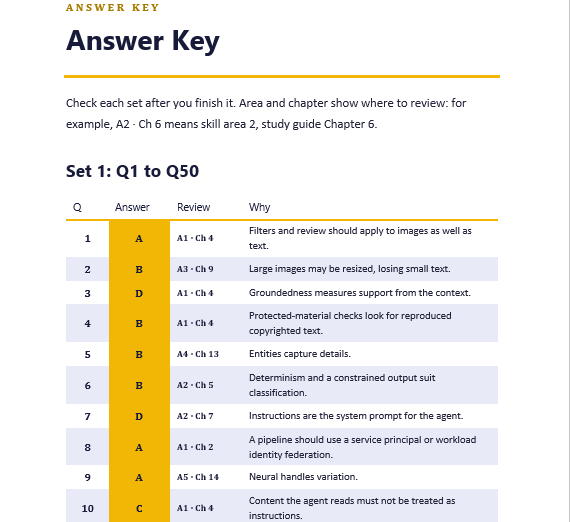
- An explanation for every answer, with the skill area and the study guide chapter to review
- A score tracker, so you can see which area is holding you back
GET THE 500 PRACTICE QUESTIONS: 500 Practice Questions
Step 3: Fix what you missed
This is where the two books work together. Take a timed set, mark it, and look at the area and chapter shown for each miss. Reread that chapter, redo its lab, and take the next set. Each pass shows you exactly where to spend your next hour.
Buy both and save: Download Both
Try two sample AI-103 practice questions.
Practice Set 1
50 questions, Q1 to Q50. Suggested time: 100 minutes. Choose the best answer for each scenario.
Q1
Which statement about safety for images is correct?
A A safe caption does not prove a safe image
B If the caption is safe, the image is always safe
C Images need no filters
D Filters work only on text
Q2
Small text in a large photo is unreadable in the service’s output. What is a likely cause?
A The content filter was too strict for the photo
B The image was resized and lost fine detail
C Streaming was switched on for the request
D The temperature was set too low for image analysis
Q3
An answer is fluent and on-topic but contains a fact that is not in the supplied context. Which score is low?
A Coherence
B Fluency
C Relevance
D Groundedness
Q4
A model sometimes reproduces copyrighted text. Which check is designed for this risk?
A Latency alert
B Protected-material detection
C Throttling retry
D Embedding refresh
Q5
In CLU, what is an entity?
A The whole conversation between the user and the bot
B A detail such as a date or city in the request
C The name of the model that was trained for the bot
D The tone in which the user wrote the request
Q6
A task needs a classification label chosen from five fixed options. Which settings combination suits it?
A Streaming enabled and a very long system prompt
B Low temperature and a schema with an enum
C Maximum top_p together with a large number of examples
D High temperature and no schema, with many free-form examples
Q7
Which agent part holds the role, rules, tone and boundaries?
A Quota
B State
C Tools
D Instructions
Q8
How should a deployment pipeline sign in to Azure without a stored secret?
A With workload identity federation or a service principal
B With an API key committed to the repository next to the pipeline file
C With a shared password written into the pipeline definition itself
D With the personal sign-in of the engineer who wrote the pipeline
Q9
Your documents’ layout varies widely between suppliers. Which custom type fits?
A Neural
B Read
C None
D Template
Q10
Which defence applies specifically to indirect prompt injection?
A Increase the temperature so the model ignores odd instructions
B Use a larger model only, because it cannot be misled by content
C Treat retrieved content as untrusted data
D Remove the system prompt so there is nothing to override