Contact us : contact@digitechgenai.com

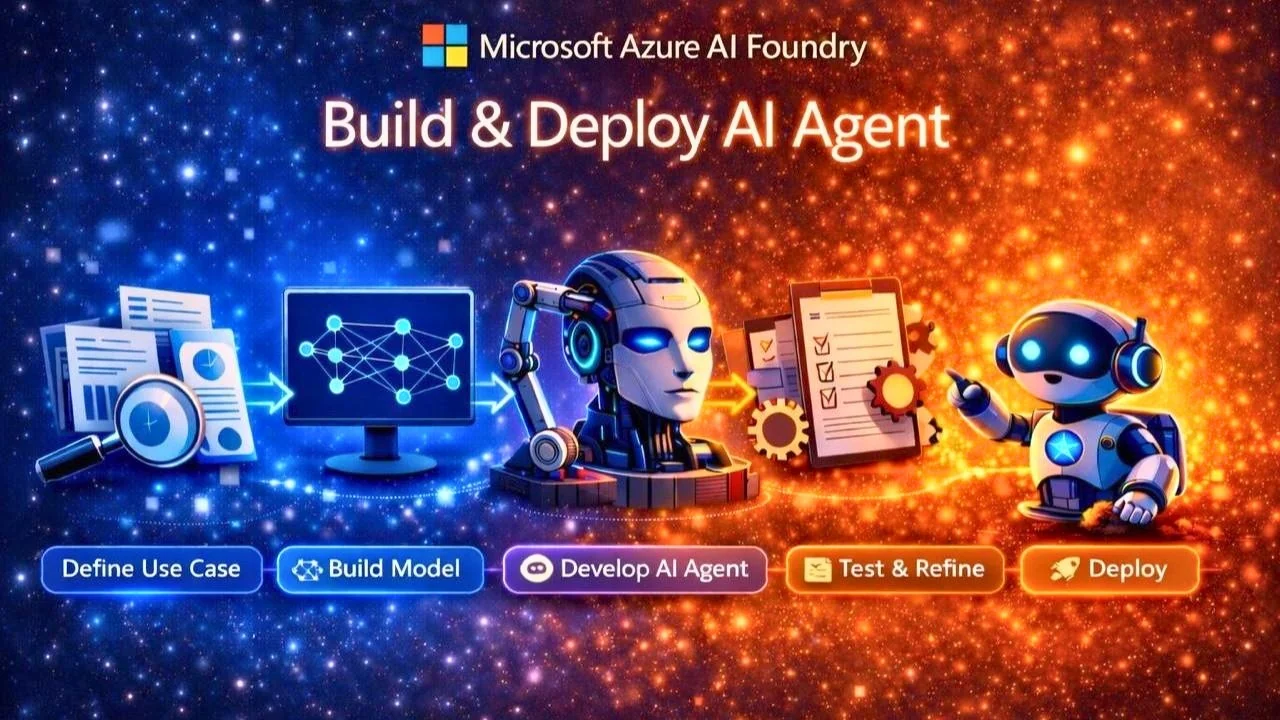

AI-103 Exam Preparation Guide (2027): Master Azure AI Apps and Agents with a Practical Study Guide
Prepare for Microsoft’s AI-103 certification with a structured, practical learning resource covering Microsoft Foundry, Generative AI, AI Agents, RAG, Azure AI Search, Computer Vision, Speech, and Document Intelligence.
The world of Artificial Intelligence is moving beyond traditional machine learning and basic chatbot development. Businesses are increasingly adopting Generative AI applications, intelligent agents, retrieval-augmented generation (RAG), and automated workflows.
Microsoft’s AI-103 certification reflects this transformation.
If you are planning to build a career in Azure AI development or want to demonstrate your ability to develop AI-powered applications and agents, the Microsoft Certified: Azure AI Apps and Agents Developer Associate certification is an important learning and career-development opportunity.
However, preparing for a technical certification requires more than memorising service names. You need to understand how Azure AI services work together, when to select a particular service, how to implement AI solutions, and how to make them secure, reliable, and scalable.
That is exactly what our AI-103 Study Guide – Developing AI Apps and Agents on Azure is designed to help you learn.
At DigiTechGenAI, we have developed a structured study resource that combines conceptual explanations, practical Python labs, exam-focused tips, common exam traps, chapter checkpoints, and an end-to-end capstone project.
Ready to begin your AI-103 preparation?
1. What Is the Microsoft AI-103 Certification?
AI-103 is the Developing AI Apps and Agents on Azure examination, associated with the Microsoft Certified: Azure AI Apps and Agents Developer Associate credential.
It focuses on the skills required to develop, manage, and deploy AI applications and intelligent agents using Microsoft Foundry and Azure AI services.
The certification moves beyond traditional AI service knowledge and focuses on practical development capabilities.
You will need to understand areas such as:
- Microsoft Foundry and AI solution architecture.
- Generative AI application development.
- Retrieval-Augmented Generation (RAG).
- AI agent development and orchestration.
- Computer Vision and multimodal AI.
- Natural language processing and speech.
- Document processing and information extraction.
- AI security, monitoring, evaluation, and Responsible AI.
The examination uses scenario-based questions. You must understand why a particular service or architecture is appropriate for a given requirement.
This is why a structured preparation resource is valuable.
2. Introducing the DigiTechGenAI AI-103 Study Guide
Product: AI-103 Study Guide – Developing AI Apps and Agents on Azure
Publisher: DigiTechGenAI
Edition: 2026
Format: Digital PDF
Length: 100+ pages
Structure: 5 exam skill areas and 16 chapters
Learning approach: Concepts + Python Labs + Exam Tips + Checkpoints + Capstone
This guide is designed to help you understand the technologies, connect the concepts, and develop practical knowledge relevant to AI-103 preparation.
Rather than presenting disconnected definitions, the book follows the five skill areas of the examination.
What makes this study guide useful?
1. Structured coverage
The content follows the five AI-103 skill areas, helping you organise your preparation around the examination objectives.
2. Practical Python labs
The chapters include hands-on exercises using Python, Azure SDKs, and relevant Azure services.
3. Exam-focused explanations
Understand the purpose of each technology and learn how to choose the appropriate solution in scenario-based situations.
4. Common exam traps
Each relevant chapter highlights common mistakes and misleading choices that can make technical questions difficult.
5. Chapter checkpoints
Test your understanding after studying each topic.
6. End-to-end capstone
Bring the concepts together by designing a support assistant that integrates AI agents, search, document processing, vision, speech, and safety controls.
3. Complete Book Summary: What Will You Learn?
The study guide is divided into five major parts covering all the key AI-103 skill areas.
PART 1: Plan and Manage an Azure AI Solution
Chapters 1–4
The first part establishes the foundation for developing secure and manageable AI applications on Azure.
You will learn:
Chapter 1: Microsoft Foundry Foundations and Choosing the Right Services
- Introduction to Microsoft Foundry.
- Models, build capabilities, and operational capabilities.
- Understanding Foundry resources and projects.
- Choosing the right Azure AI services.
- Differences between functions, workflows, and agents.
Chapter 2: Setting Up AI Solutions and Designing Infrastructure
- Creating Foundry resources and projects.
- Deploying AI models.
- Understanding deployment types and capacity.
- Azure infrastructure design.
- Managing service connections.
- CI/CD and infrastructure as code.
Chapter 3: Managing, Monitoring and Securing AI Systems
- Microsoft Entra ID and role-based access control.
- Managed identities.
- Private endpoints and network security.
- Azure Key Vault.
- Monitoring AI applications.
- Token usage, latency, and cost management.
- Application Insights and OpenTelemetry.
Chapter 4: Responsible AI and Evaluating Models and Apps
- Six Responsible AI principles.
- Content safety and guardrails.
- Prompt injection and jailbreak protection.
- Human oversight for AI agents.
- Groundedness and relevance evaluation.
- Model evaluation and red teaming.
What you gain: An understanding of how to plan, configure, secure, monitor, and evaluate Azure AI solutions.
PART 2: Implement Generative AI and Agentic Solutions
Chapters 5–8
Generative AI and agentic development form the central technical focus of this guide.
You will learn how to build AI-powered applications that can generate content, retrieve enterprise knowledge, interact with tools, and execute multistep tasks.
Chapter 5: Building Generative AI Applications
- Chat completion and message roles.
- System, user, assistant, and tool messages.
- Temperature, top_p, and max tokens.
- Prompt engineering techniques.
- Structured JSON output.
- JSON Schema.
- Multimodal inputs and streaming.
Chapter 6: Grounding Models with Your Data – RAG and Azure AI Search
- Understanding Retrieval-Augmented Generation.
- RAG versus fine-tuning.
- Document chunking and embeddings.
- Azure AI Search indexes.
- Keyword, vector, and hybrid search.
- Grounded responses and source citations.
- Building a practical RAG application.
Chapter 7: Building Agents with Foundry
- Understanding AI agents.
- Agent architecture and agent loops.
- Function calling.
- Knowledge retrieval tools.
- OpenAPI integrations.
- Azure Functions.
- Model Context Protocol (MCP).
- Conversation state and memory.
Chapter 8: Orchestration, Monitoring and Optimising Agentic Systems
- Sequential orchestration.
- Concurrent orchestration.
- Handoff patterns.
- Manager and group-chat patterns.
- Agent monitoring and tracing.
- Error analysis.
- Cost and latency optimisation.
- Operationalising AI applications.
What you gain: Practical knowledge of how modern Generative AI applications and intelligent agents are designed and developed.
PART 3: Implement Computer Vision Solutions
Chapters 9–10
Computer Vision enables applications to understand and work with visual information.
This section covers:
- Analysing images.
- Image classification and object detection concepts.
- Image understanding using Azure AI Vision.
- Multimodal AI capabilities.
- Image generation.
- Working with video.
- Choosing the right vision solution for a business requirement.
What you gain: An understanding of how to implement image and visual AI capabilities in Azure applications.
PART 4: Implement Text Analysis Solutions
Chapters 11–13
This part explores language-related AI services and conversational applications.
Chapter 11: Analysing Text with Azure AI Language
- Text analytics.
- Sentiment analysis.
- Key phrase extraction.
- Named entity recognition.
- Personally identifiable information (PII).
- Language detection.
Chapter 12: Speech and Translation
- Speech-to-text.
- Text-to-speech.
- Speech translation.
- Working with speech-enabled applications.
Chapter 13: Conversational Solutions
- Conversational AI.
- Chatbot development.
- Intent recognition.
- Conversational workflows.
- Handoff and integration concepts.
What you gain: Knowledge of how to develop intelligent language, speech, translation, and conversational applications.
PART 5: Implement Information Extraction Solutions
Chapters 14–16
The final part focuses on extracting meaningful information from documents and building searchable knowledge systems.
Chapter 14: Extracting Information from Documents
- Azure AI Document Intelligence.
- Document processing.
- Extracting structured information.
- Working with forms and invoices.
- Prebuilt and custom extraction approaches.
- Human review and confidence considerations.
Chapter 15: Knowledge Mining with Azure AI Search
- Knowledge mining architecture.
- Data sources and indexers.
- Skillsets and enrichment pipelines.
- OCR and document processing.
- Index management.
- Change and deletion detection.
- Monitoring indexing operations.
Chapter 16: Exam Strategy and Capstone
- Understanding scenario-based exam questions.
- Exam preparation strategy.
- Common exam mistakes.
- Final readiness checklist.
- End-to-end AI support assistant capstone.
- Eight-week preparation roadmap.
What you gain: An understanding of document intelligence, information extraction, knowledge mining, and how to combine multiple Azure AI capabilities in one application.
4. Learn Through Practical Python Labs
One of the important features of this book is its hands-on learning approach.
Each main chapter includes a practical lab designed to help you connect the theory with implementation.
Examples include:
| Technology | Practical learning activity |
|---|---|
| Microsoft Foundry | Connect to a Foundry project |
| Azure AI | Deploy and access models |
| Azure Monitor | Track token usage and traces |
| AI Evaluation | Evaluate groundedness and relevance |
| Generative AI | Extract structured support-ticket data |
| RAG | Implement hybrid search and grounded responses |
| AI Agents | Build a function-calling loop |
| Agent orchestration | Develop a sequential multi-agent flow |
| Azure AI Search | Build and monitor an indexing pipeline |
The labs use Python and Azure SDKs.
You should have Python 3.10 or later, Azure CLI, and a suitable Azure subscription.
Important: Azure resources created during the labs can incur charges. Review the applicable pricing and delete resources when finished.
5. An Eight-Week AI-103 Study Roadmap
The book includes a structured eight-week study plan to help you approach preparation systematically.
| Week | Study focus | Expected learning output |
|---|---|---|
| 1 | Foundry, setup and security | Working project with deployed model |
| 2 | Monitoring, Responsible AI and evaluation | First evaluation run |
| 3 | Generative AI and RAG | Grounded question-answering application |
| 4 | Agents and orchestration | Tool-using agent with traces |
| 5 | Computer Vision | Image captioning and generation |
| 6 | Language, speech and conversation | Voice or chat assistant |
| 7 | Documents and knowledge mining | Indexer and invoice extractor |
| 8 | Capstone and revision | Timed practice session and knowledge-gap list |
You can adjust the schedule according to your experience and available study time.
A recommended approach is to read one chapter, complete its lab, and revisit its checkpoint after a week.
6. Who Should Buy This AI-103 Study Guide?
This study guide is suitable for learners who want a structured approach to Azure AI development.
Azure Developers
Developers who want to expand their knowledge from conventional Azure development into Generative AI and intelligent agents.
Software Engineers
Java, Python, .NET, and other software developers interested in building AI-powered applications.
Cloud and AI Professionals
Professionals working with Azure cloud platforms who want to understand Microsoft Foundry and modern AI architectures.
AI and Generative AI Learners
Learners interested in RAG, AI agents, prompt engineering, multimodal AI, and conversational applications.
AI-103 Certification Candidates
Individuals preparing for the Microsoft Certified: Azure AI Apps and Agents Developer Associate examination.
Recommended prerequisites
You should be comfortable with:
- Basic Python programming.
- REST APIs or SDK usage.
- Azure subscriptions and resource groups.
- Basic cloud concepts and role-based access control.
Prior machine learning experience is not required.
7. Why Choose a Structured Study Guide Instead of Random Online Tutorials?
Free online resources are useful, but preparing from scattered tutorials can make it difficult to maintain a consistent study plan.
A structured study guide provides:
| Random learning approach | Structured study guide |
|---|---|
| Topics spread across different resources | Organised chapter structure |
| Difficult to track progress | Chapter checkpoints |
| Theory may be disconnected from implementation | Practical Python labs |
| Easy to miss important concepts | Five exam skill areas |
| Limited exam-focused revision | Common traps and exam tips |
| No single implementation journey | End-to-end capstone |
The objective is not to replace official Microsoft documentation.
Instead, this book provides a structured learning and revision resource to help you understand the technologies and prepare more systematically.
8. Frequently Asked Questions
Q1. What is the AI-103 certification?
AI-103 is Microsoft’s Developing AI Apps and Agents on Azure examination, associated with the Azure AI Apps and Agents Developer Associate credential.
Q2. Is this book suitable for beginners?
The book is suitable for developers and learners with basic Python and Azure knowledge. It does not require prior machine learning experience.
Q3. Does the study guide include practical labs?
Yes. It includes Python-based hands-on labs covering Microsoft Foundry, model deployment, RAG, AI agents, evaluation, monitoring, and Azure AI Search.
Q4. Does the book cover Microsoft Foundry?
Yes. Microsoft Foundry is a central topic throughout the guide, including resources, projects, models, agents, tools, evaluation, security, and monitoring.
Q5. Does this book include practice examination questions?
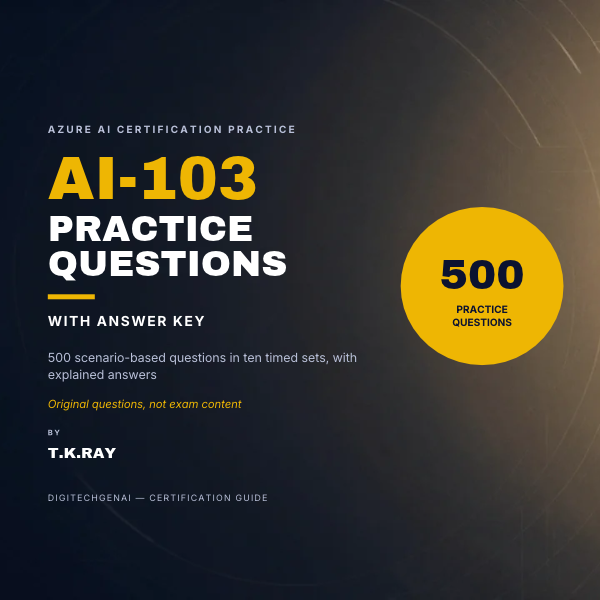
The practice-question collection is sold separately as a companion bundle. It is not included in the 100-page study guide.
Q6. How long should I spend preparing?
The book suggests an eight-to-ten-week preparation period with a few hours of study per week. Your actual preparation time will depend on your experience.
Q7. Does the book guarantee certification success?
No. The guide is a learning and preparation resource, not a guarantee of passing the examination. Combine it with practical labs, official Microsoft Learn resources, and sufficient revision.
Q8. Is this book officially published or endorsed by Microsoft?
No. This is an independent study guide published by DigiTechGenAI. It is not affiliated with, endorsed by, or sponsored by Microsoft.
Q9. Are the technical examples guaranteed to match the latest Azure SDK versions?
Azure SDKs, service names, portal interfaces, and exam objectives can change. Always verify the current implementation details against official Microsoft documentation.
9. Start Your AI-103 Certification Preparation Today
Artificial Intelligence is changing how software applications are designed, developed, and deployed.
Understanding Generative AI, Microsoft Foundry, RAG, AI agents, computer vision, language services, and document intelligence can help you build valuable technical capabilities.
If you are serious about developing your Azure AI skills, start with a structured learning approach.
The DigiTechGenAI AI-103 Study Guide – Developing AI Apps and Agents on Azure brings the five examination skill areas together in one practical learning resource.
What you get
- 100-page digital PDF study guide.
- Five major AI-103 skill areas.
- Sixteen structured chapters.
- Practical Python labs.
- Exam-focused explanations.
- Common exam traps and chapter checkpoints.
- Eight-week study roadmap.
- End-to-end AI application capstone.
Build your knowledge. Practise with Azure. Prepare with confidence.
Get Your AI-103 Study Guide Now
Explore the DigiTechGenAI learning resources and take the next step towards developing modern Azure AI applications and intelligent agents.
DigiTechGenAI – Smart Solution with Digital World.
Disclaimer: This is an independent educational study guide. Microsoft, Azure, Microsoft Foundry, and related product names are trademarks of Microsoft Corporation. This publication is not affiliated with, endorsed by, or sponsored by Microsoft. Always check the latest official AI-103 examination objectives and documentation before taking the examination.
© 2026 DigiTechGenAI. All rights reserved.
Explore more Books : AIF-C01