Contact us : contact@digitechgenai.com

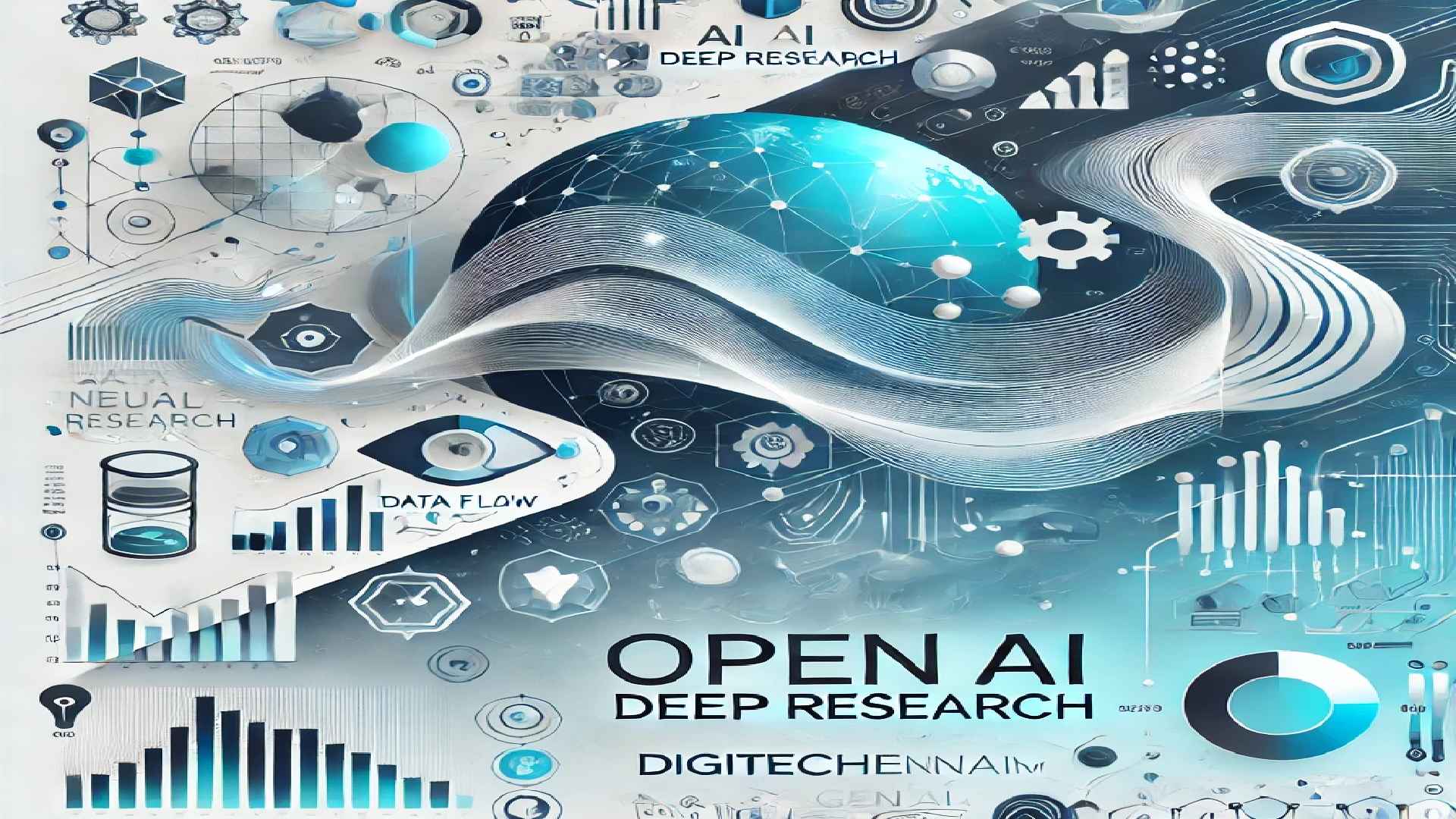

OpenAI Deep Research
Traditional AI search is reactive: you ask a question, and the model scans top search results to extract a summary snippet. OpenAI Deep Research replaces this with an agentic, multi-step investigation loop.
Instead of generating instant, single-turn responses, Deep Research operates as an autonomous research analyst. It plans an investigation, queries dozens of external web sources, parses complex documents, cross-verifies findings, and delivers publication-grade synthesis complete with inline citations.
What is OpenAI Deep Research?
OpenAI Deep Research is an agentic research tool integrated into ChatGPT designed to automate hours of complex, manual information gathering. Rather than answering in seconds, a Deep Research task typically runs for 5 to 30 minutes, executing recursive search paths, following references, and synthesizing hundreds of online sources into a comprehensive, structured briefing.
Unlike standard ChatGPT web browsing, Deep Research exhibits true multi-step reasoning:
- Formulates structured research plans before touching the web.
- Reads and evaluates long-form documents, including PDFs, spreadsheets, and academic literature.
- Performs autonomous backtracking when initial search paths hit dead ends or unreliable data.
- Produces cited, downloadable reports formatted with executive summaries, comparative tables, and full source attribution.
How Deep Research Works: The Agentic Workflow
Deep Research follows an autonomous, 5-stage agentic lifecycle:
[ User Prompt ]
       │
       ▼
1. Clarification & Scoping (Interactive Q&A)
       │
       ▼
2. Research Plan Generation (User Editable)
       │
       ▼
3. Autonomous Multi-Pass Web Retrieval (5–30 Mins)
       │
       ▼
4. Source Verification & Data Cross-Check
       │
       ▼
[ Full Report with Tables & Citations ]
1. Scoping and Clarification
When you trigger a deep research prompt, the agent clarifies ambiguous variables before consuming compute. It may ask about preferred geographical regions, technical depth, target audience, or specific timeframes to tighten the boundaries of its investigation.
2. Research Planning and Steering
ChatGPT drafts a formal research outline detailing proposed search angles and key sub-questions. Users can inspect, edit, or steer the plan directly—allowing you to restrict research to approved domains (e.g., official documentation or peer-reviewed journals) or attach private reference files.
3. Iterative Multi-Pass Browsing
The model activates an internal browsing agent. As it gathers data, it evaluates source credibility, discards marketing fluff, identifies contradictory claims, and spins off secondary search queries to verify facts.
4. Comprehensive Synthesis
All gathered evidence is synthesized into an extensive report. The final output includes:
- Interactive Table of Contents: Jump between sections and sub-analyses.
- Inline Verifiable Citations: Direct hyperlinks to every referenced source.
- Structured Data Tables: Side-by-side matrices for pricing, features, or benchmarks.
- Full Research Activity Log: A transparent timeline showing every query executed and site evaluated.
- Export Options: One-click export to Markdown, Microsoft Word (.docx), or PDF.
Benchmark Performance: Expert-Level Reasoning
OpenAI Deep Research achieves state-of-the-art results on expert benchmark evaluations, particularly on Humanity’s Last Exam (HLE)—a benchmark testing domain knowledge across more than 100 graduate-level subjects:
| Model / Agent | Humanity’s Last Exam (HLE) Score | Approach |
|---|---|---|
| OpenAI Deep Research | 26.6% | Multi-pass agentic search + advanced reasoning |
| DeepSeek R1 | 9.4% | Single-pass extended thinking |
| Gemini Thinking | 6.2% | Integrated web search with reasoning |
| Claude 3.5 Sonnet | 4.3% | Standard generation |
| GPT-4o | 3.3% | Direct conversational retrieval |
The largest margins of improvement occur in high-rigour fields such as chemistry, engineering, competitive intelligence, and law, where surface-level search snippets fail to provide nuanced answers.
Standard ChatGPT vs. Deep Research
| Feature | Standard ChatGPT Search | OpenAI Deep Research |
|---|---|---|
| Execution Time | 2 to 10 seconds | 5 to 30 minutes |
| Search Depth | 2–5 primary links | Dozens of recursive sources, PDFs & reports |
| Investigation Style | Single-pass, reactive | Multi-pass, proactive, iterative |
| Planning Phase | None | Collaborative, user-editable research plan |
| Output Type | Short answers & summaries | 10–30 page structured briefing reports |
| Export Formats | Copy text | PDF, Word (.docx), Markdown |
| Best Used For | Quick facts, news, definitions | Market research, vendor analysis, due diligence |
Practical Business and Developer Use Cases
1. Market and Competitive Intelligence
Run exhaustive competitor sweeps across pricing models, customer sentiment on review aggregators, target positioning, and feature roadmaps without manual tab-hopping.
2. Technical Stack and Vendor Evaluations
Prompt Deep Research to benchmark cloud infrastructure components, APIs, or database solutions (e.g., “Evaluate Spring WebFlux vs. Quarkus for high-throughput reactive microservices with benchmark data and cloud maintenance overhead”).
3. Regulatory and Compliance Audits
Analyse overlapping regulatory frameworks (such as GDPR, DPDP, and HIPAA) across multiple jurisdictions, compiling explicit policy differences into structured comparison matrices.
4. Academic and Technical Literature Reviews
Synthesise preprint papers, whitepapers, and patent filings on emerging machine learning architectures or materials science developments.
Plan Availability and Usage Tiers
OpenAI provides deep research across tiers to balance significant inference compute requirements:
- ChatGPT Pro: Highest monthly allocation for heavy research workflows, with extended search depth and session runtimes.
- ChatGPT Plus & Business: Standard research quota for professional day-to-day analysis. When high-compute quotas are met, queries seamlessly roll over to optimized lightweight runs.
- Enterprise & Education: Includes administrative role-based access control (RBAC), workspace data protection guarantees, and integration with workspace-connected repositories (e.g., Google Drive, SharePoint).
- Free & Go Tiers: Limited promotional research tasks to test agentic workflows.
Best Practices for Writing OpenAI Deep Research Prompts
To get the highest-value reports from Deep Research, avoid broad single-sentence prompts. Use structured prompts that outline context, requirements, and constraints:
Plaintext
Act as a Principal Enterprise Architect.
I need a comprehensive evaluation of migrating a monolithic Java application to event-driven microservices on AWS.

Key Requirements:
1. Compare Kafka on Amazon MSK vs. Amazon EventBridge (throughput, latency, cost at 50,000 events/sec).
2. Detail state management and data consistency patterns (Saga vs. 2PC).
3. Outline real-world failure modes and migration risks.

Deliverable:
- Provide an Executive Summary.
- Include structured comparison tables for cost and performance.
- Restrict references to official documentation and verified engineering case studies.
The Road Ahead
Deep research signals a structural transition in generative AI—moving beyond chat interfaces toward autonomous agentic labor. As models gain deeper tool-use capabilities, custom MCP (Model Context Protocol) integration, and enterprise connectors, autonomous research workflows will become the baseline for technical, financial, and strategic decision-making.
Read more – https://openai.com/index/introducing-deep-research/
For Other Blogs – https://digitechgenai.com/ai-prompt-playbook-your-next-career-move/